Blade Runner (#7): Complete Movie Analysis
Blade Runner (1982)
A Complete Film Analysis/Review by Sean Gregory, Quinn Saggio and Mazen Zaki
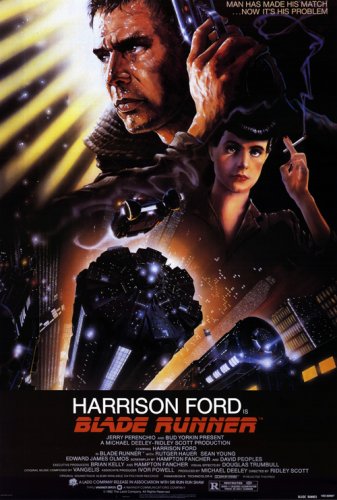
Director: Ridley Scott
Writers: Hampton Fancher & David Webb Peoples
Based on the novel Do Androids Dream of Electric Sheep by Philip K. Dick
Lead Actors: Harrison Ford (Rick Deckard), Rutger Hauer (Roy Batty), Sean Young (Rachael)
Running Time: 1 hour 57 minutes
Trailer:
____________________________________________
Plot:
The year is 2019. In this time period, robots known as Replicants have become a common sight, and have been assigned with performing tasks considered too dangerous for humans. Replicants are specifically designed to be similar to humans, but faster, stronger, smarter, having a lifespan of about 4 years, and not having emotions as developed as humans do. The most recent model of replicants, the Nexus 6, have been embedded with memories of the deceased as a means to make them more lifelike. The only way that they can distinguish these replicants from humans is with a test known as the Voigt-Kampff test, which asks the person a series of questions and can tell by their different emotional responses and answers who is human and who is a replicant. The Nexus 6 models were meant for multiple purposes, both on and off Earth. However, after a mission outside of Earth where one of them started murdering humans, Nexus 6 replicants are considered ‘guilty’ and have been banned from Earth. If humans ever confronted any Nexus 6 models, they were told to kill, or ‘retire’, them. The people responsible for hunting down these robots are a specialized branch of the police force known as ‘Blade Runners’.
The main focus of the story is on one Rick Deckard. He is a retired Blade Runner who’s been called back into action by his former superior Bryant to take care of four rogue Nexus 6 models who came back to Earth illegally: Pris, Zhora, Leon, and, their leader, Roy. Before Rick goes, Bryant leads him to the creator of the replicants, Tyrell, who tells him of a new Nexus 7 model he's working on, who has immensely boosted emotional responses and emotional procedure. It enables to camouflage itself, even further into human society, as it can answer up to a 100 questions on the Voigt-Kampff procedure that he’s been working on that implants false memories of a once living human into a replicant. This is the case for his replicant assistant, Rachael, who’s been implanted with the memories of Tyrell’s niece and believes that these memories are her own. As the story progresses, we get to see both Rachael come into acceptance that she’s a replicant and Rick ‘retiring’ the replicants. However, we’re thrown a curveball when we learn that the replicants are actually back on Earth because they know that they’re eventually going to shut down and want to learn how to live longer. Tyrell and Sebastien, the other creator, sadly have no answers for them, so they respond in a blind rage by killing them. This entire movie revolves around emotions; the robots try desperately to feel emotions, but they fail. The only thing they know is that they are going to die soon and must get the answers before they do. In the end, both Rick and Roy learn that there will never be an answer to living forever, both as a Replicant and as a person, and that it’s best to live life to its fullest in the short amount of time you have left. This movie was a staple of the science fiction genre in cinema, and popularized a certain branch of sci-fi known as “cyberpunk”. This genre tends to focus on a combination of high tech machinery, such as scientific achievements and artificial intelligence, put closely together with a breakdown in the social order, also known as people of lower class.

Blade Runner has many amazing cinematic techniques in use, as it should be when it’s directed by legendary director Ridley Scott. Here are some examples of great filming shots: Near the end of the film, where Rachael’s in the grey bag, the camera pans slowly around the object that is hidden from view and not around the room. This action creates suspicion and dread for what is to be found inside: Although it doesn’t share much about the setting, it indicates its importance by focusing on that particular object, thus focusing the audience’s attention on it over a longer period of time. Another example would be the low-angle shot, Roy over Deckard trying to indicate his supremacy. This demonstrates a power level gap, whereas Deckard is only human and is scared for his life, Roy is shown to be larger than his opponent and seems more confident and stronger thanks to the angle that this scene was shot in.
When talking about lighting, it's important to mention that most of the movie was shot in darkness, either to uphold a futuristic style or to uphold a dystopian style. However, there were some parts of the movie that outshone the typical darkness of the film. One such example is the intense darkness of Sebastien's house. When Pris and Sebastien are walking through his creepy mannequin doll house, it provides a heavy amount of amazing darkness in order to emphasize the fact that he lives completely alone. He is essentially cut off from the rest of the world, which is something that is bound to happen in a dystopian futuristic movie. There's also elements of sunlight that exist within the movie, such as Tyrell doing the Voigt-Kampff test on Rachael. Before she's tested, the large windows of the building let in a lot of sunshine, thus signifying a sort of positivity to the movie. However, when they start, the shades get lowered and the room is enveloped in darkness, perhaps signifying a sort of emotionless force that exists ie. Rachael.
There are also some great musical pieces, whether entire scores or character sounds, within the movie. For example, the diegetic sound of the short, hoppy, and abnormal music that plays in most of the movie's tense moments. It really brings up the ante for the eerie look that the movie wants to have, since it wants you to be at the edge of your seat wondering what will happen. As well, there's Rick voice lines in the movie, which are very sharp and serious, as the character plays the role of a battle-hardened protagonist, while the other humans in the movie have a more mellow and fun tone to them. The different Replicants are also played very similarly: emotionless and questioning.
Blade Runner has some rather iconic movie props used, and most of them either back up the genre of cyberpunk in terms of its futuristic look or go back in time with its older 60s look. For example, the computer used when Rick is tracking down Zhana. The idea of telling the computer what to do and the computer complies to the order made is an idea that’s well known in our current time period, but almost foreign in the time period of this movie’s filming. For another thing, the computer is used in such a way that it does make us think of the future, since, at the time, that was similar to the technology we have today, but with a more complex outlook to the audience. As well, the cigarette is another interesting prop used. Back in the 70s and 80s, smoking was a very relevant and common part of peoples’ lifestyle, so they would obviously incorporate it into their movie. However, what’s also interesting is that they put common smoking as a part of their movie’s date of November 2019, only a few months away from our current time period. Currently, the amount of smokers in the human population has gone down, bt hasn’t gone away. Perhaps Blade Runner might have predicted the events of us picking up smoking again, but we won’t know until November hits. Overall, the cigarette adds that texture of 1960s and 70s to the mix of the futuristic dustpan that the movie sets up for.
Finally, it wouldn’t be a proper movie without great characters to back it up, and it wouldn’t be proper characters without the great actors who played them: Rutger Hauer as Roy was seriously interesting to watch, as he had multiple different types of personality, and didn’t quite fit the bill for a major villain. He was actually someone that the audience could feel sorry for. He was given a very short lifespan, told that, if he goes to Earth, he’ll die, and even when he had every opportunity to kill Rick at the movie’s end, he pulls him up and lets him live right before he dies himself. This character was an unexpected rollercoaster of emotions that was both interesting and fun to watch. There was also Sean Young as Rachael, who brought another character of multiple layers to life. She was a character that separated the boundary between the two black and white sides of humans and Replicants. Naturally, a character that’s the grey area between the 2 sides is the most relatable, as she can be felt on either side of the coin. Rachael is no different to this, as she struggles both with the problems of humans (blending in, not feeling not entirely at home, etc.) and Replicas (short battery life, about to ‘retire’ soon, etc.) which made her the most relatable and, thus, the most interesting to watch on screen. Young portrayed this character in almost every right way possible with having her be a Replicant searching for answers, similarly to Roy, but to less of an extreme, as if she’s accepted that she’s going to die soon. Aside from Rutger Hauer’s performance, Sean Young was one of the most interesting characters to watch on screen, as her raw emotions let loose and her timid side took a front row seat for a timid and curious Replicant woman.

This movie addresses some very interesting themes. One of these interesting themes is the idea of killing and the morality that comes with it. Deckard is tasked with hunting down AIs, robots, but when they look and act like humans, it does sometimes feel like murder. This same idea can be brought back to our modern world where we have issues like illegal hunting for sport and poaching for the black market. Some humans don’t consider killing animals to be that hard of a moral choice and that is reflected in Deckard’s actions when he hunts down the replicants. He considers these replicants as non-human beings and so his morality is protected based on his beliefs.
Another theme is the difference between robots and humans, more specifically with Rick’s relationship with Rachael. All of the Replicants are programmed to be better than humans in every way except for emotional responses. When Tyrell designed Rachael, he made sure that she was able to be even better at emotional responses than the normal replicants. Rachael represents a barrier between the replicants and the humans, also known as man vs. machine, since Rachael is both too human-like to be considered a replicant and a non-human replicant.
A final theme to mention is the idea of remorse, more specifically with Roy and Rick. We all know the the main plot point of the movie is emotion. Replicants have been shown to have emotions that are inferior to humans. We also know that the replicants, specifically Roy, have spent countless hours searching for the key to live longer lives. However, the idea of Roy being bad is thrown for a curve as Roy, while having the high ground against Rick in the final fight, actually saves him. He could've easily killed him, but he doesn't. What ends up happening afterwards is him shutting down from his incredibly short battery life. As much as we know that he's both a replicant and the movie's main villain, we can't help but feel a bit of remorse for Roy. This is mostly because Roy finally feels remorse: a very strong and complex emotion. What should also be mentioned is that remorse is the last emotion that we'd think of replicants having. When we finally see Roy develop what he's always wanted, which was a way to be more similar to humans, then see it all be taken away as he breathes his last robotic breath, is kind of heart-shattering.
(2,041 words)

Review:
In a movie that tries to ask the questions of “Who are we? How are we any different than robots?”, it ends up asking questions like “What on earth is happening right now? Why does this scene need to be here? What purpose does this serve to the story?”. As a whole, most of the plot was alright, yet like all movies, it had its ups and downs. It was a huge undertaking for director Ridley Scott and was revolutionary at the time. Ridley made some great casting choices, like casting Rutger Hauer to play Roy, the movie’s main villain. His raw talent and great emotion gave the movie some much-needed emotion, despite Roy being a robot. As well, some of the shots, even those that only served as filler for the movie’s runtime, were beautiful to look at, if not very dark.
However, it had some serious flaws in both its plot and its characters. It had plot point after plot point after plot point and was getting extremely confusing to listen to many times. One would figure that the questions stemming from these plot points would be answered in possible sequels, but given that the book sequel to Blade Runner came out in 1995, and the movie sequel came out in 2017, they’d have to wait a long time for that to happen. Where the movie got bad, however, was in the acting. Almost all of the actors in the movie, with the exception of Rutger Hauer and a few others, just lazily jumped around the screen and lazily read their lines, which causes a situational bore. It’s very ironic that the actors who play the Replicants have the least robotic acting out of every character in the movie. What got to me the most, however, was Harrison Ford’s acting. I’ve seen Star Wars and Indiana Jones, so I’ve definitely seen Ford’s brilliant acting beforehand. With this movie however, it feels like he was acting at gunpoint. None of the dialogue seemed natural, and it seemed even less natural when Ford was tasked with playing such an out-of-element character like this. Is it a classic? Yes. Does it deserve the insane amount of admiration that it’s gotten? No.
Overall, this movie bit off more than it could chew. Putting credit where credit is due, however, this movie did come out more than half a decade ago, and it’s still being talked about, so it had to have done something right. Plus, this was one of Ridley Scott’s first films, and was a stepping stone in his enormous success. This movie is recommendable to people, but not for the reason that it’s good. Similarly, to The Phantom Menace in Star Wars, the first Blade Runner is good for people to see as it shows them how much the series has grown since its debut, not necessary saying that the movie was good, but that the series has gotten progressively better. The hardest part of a series is actually starting it, and, according to many, Blade Runner started the cyberpunk genre off amazingly.

I would give this film 3 stars out of 5. This movie was made over 35 years ago, inspired the now-iconic subsection to sci-fi known as cyberpunk, and was one of the movies that rose Ridley Scott into extreme success as a director. Even though this film was a pioneer in its genre, as a whole however, it took way too many twists and turns for a single movie and this led to confusion in some scenes, to make us wonder the reason of “why did the characters make those decisions?”, this can be felt off and on throughout the film, especially in the ending. The film, although great actors themselves, had some very stale acting choices for it and from the confusion, it felt extremely open to interpretation. Finally, the movie was always enveloped in literal darkness, which may have been the intent to give off a noir look into the future, but still made the film difficult to look at and observe the details in the scenes.
_______________________________________________________________________________________
Connections with course concepts:
Thus far in our Knowing the Inner Self class, we have been given many themes and concepts that questions both our own knowledge and the knowledge of others. However, both have had one theory in common: the knowledge of robots. Here are three course concepts that are explored through this movie:
Epistemology is a key course concept that has come up a lot throughout this film. It follows knowledge: what is it, what do we know, how do we know what we know is true, and is knowledge only considered knowledge if it can be proven, etc...? The film is built upon artificial intelligence, where it has robots that can think and answer logically, and with the new model, these robots that have memories. This raises interesting developments when the AI begins to wonder and think about itself, such as “What does it mean to be human?”. Does this mean we have an actual conscious or does it have to do with our awareness of our environments? “What is reality?”, which corresponds with Descartes philosophy of our mind/body relationship and how can we really know the replicates are thinking creatures. “What is the difference between real memories and artificial memories?”, how can we distinguish these two apart? Are their memories real? The AI begins to wonder if what they know to be their past...actually is their past or not. In the scene where Deckard tells Rachael that she’s a replicant, they’re talking about the piano and Rachael responds with “I didn't know if I could play. I remember lessons. I don't know if it's me or Tyrell's niece.” Her wonder of whether what she knows is real or not is a direct relation to the this epistemological thought. In another scene, Roy wanders into a eye manufacturer's workshop and he speaks to the worker. “Questions” he says, and he is responded with “I don’t know answers”, where Roy then exclaims “Who does?”. He brings up these ideas of who knows what is real and what’s not, this mirrors his own feelings and the feeling of the entire film because they are on a quest for knowledge, to find their maker. This just goes to show that mental boundary of the new AIs are seemingly unlimitless with the addition of memory and emotions, and it makes the search for truth even more important for them.
The Uncanny Valley: This key concept is extremely accurate for much of the film, as the robots are specifically designed to be “superior in strength and agility, and at least equal in intelligence, to the genetic engineers who created them” (Blade Runner). This leads into a very relevant and unsettling concept known as the uncanny valley. This concept, in term, talks of robotic features, attitude, and behaviour that are nearly identical to human behaviour, so much so that no one can tell any differences between them. The robots almost cross this line of uncanny valley, but are robotic enough that they aren’t as unsettling as they could be. However, what truly is unsettling is Tyrell’s masterpiece of a replicant known as Rachael. The movie states that Rachael can be identified as a replica after a hundred question from the Voigt-Kampff test. In comparison, the greatest replicas, including Leon, Roy, and many others, are able to be identified after twenty or thirty questions. This sheer level of emotional similarity that Rachael has with humans dives very deep into the uncanny valley in many different levels. It’s not only nearly impossible to tell the difference, but it makes you think: can anyone I know be a replicant?
Metaphysics: The film Blade Runner explores what it means to be human, and what defines us to be human. The replicants who are made of synthetic material are built as slave labor but are also programmed to have emotions, while the humans who made them are seen as heartless and arrogant. It is obvious throughout the movie that these replicants are more human than humans and plays as the main theme throughout the entire movie. With the introduction of memory into the newer model of replicants, this forms a connection between the physical realm and what one cannot see, constructing a bridge between matter and the immaterial mind. As memory used to be a quality only humans had, this new addition to the replicants blends the two realms together.

Finally, this film raises some very philosophical questions about our own world, which are both interesting and provocative. These are question that we're purposefully leaving blank so that we can hear what you as an audience who has new viewpoints could say about them:
- A key puzzle raised by Blade Runner is whether we can definitively distinguish between real humans and artificially engineered replicants. Suppose that no test (either objective or subjectively introspective) could show this for sure. Would that mean that a given replicant was indeed fully human?
- In terms of their "humanity," who was more human in the film, the replicants or the humans? Why?
- Could robots ever have the same self-aware self of consciousness as humans or will machine being able to experience and reflect always be considered impossible._________________________________________________________________________________To help in our research, we have provided some sources to further delve into the deep and complex world of AI:This website introduces Sophia, one of the most developed AIs of today. It explains her role, what she is made and composed of and how close she is to what we consider consciousness. The purpose of this website is to give a starting point into what AI looks like, as we can see, the face resembles a human but the torso has wires and motherboards and even though it is not completely human, it represents a new fusion between material and flesh that can be used to understand what Replicants are in the film.This article explains what memories are and why they are important. It tells that memories are what make us who we are because our experiences with our interactions in the world dictate responses that we can use later in life. This relates to our film because we can learnt that with the addition of memories into the replicants, this allows for higher reflection and cognitive abilities.Works Cited“Your Memories Make You Who You Are.” Psychology Today, Sussex Publishers, www.psychologytoday.com/us/blog/psychoanalysis-unplugged/201708/your-memories-make-you-who-you-are.“Sophia.” Hanson Robotics, www.hansonrobotics.com/sophia/.


A key puzzle raised by Blade Runner is whether we can definitively distinguish between real humans and artificially engineered replicants. Suppose that no test (either objective or subjectively introspective) could show this for sure. Would that mean that a given replicant was indeed fully human?
ReplyDeleteEven though there would be no given way to identify whether or not someone was a real human or an artificially engineered Replicant, there would still be a part of the Replicant that keeps them from being fully human. Replicants may be similar to humans in many ways such as strength, intelligence and the ability to possess emotions like humans do, however, Replicants were still programmed which causes a divide between them and humans. In the film, Tyrell is responsible for implanting memories that once belonged to a human into a Replicant, therefore they lack an important aspect of being human. The basis of our being is based off of experiences and memories we gain throughout our life, therefore those memories are unique to everyone. Having these memories implanted into the Replicants almost causes a “false” sense of being and differs them from humans because the memories in which they possess are not theirs. Even though the Replicants look identical to a human they are still composed of synthetic materials and false memories. In the blog, the group touches upon the question of “What is the difference between real memories and artificial memories?” when discussing epistemology. This question goes to show the difference between AI and real humans, as Replicants are programmed with real memories but they do not belong to them. It is difficult because memories can be real, but only to the person who has experienced it. Therefore the memories in which Replicants withhold are artificial to them, creating a disconnect from being fully human.
Chantal Klumpenaar
In terms of their "humanity," who was more human in the film, the replicants or the humans? Why?
ReplyDeleteIn this film, I would argue that the replicants displayed far more humanity than some of the humans. When comparing replicants such as Rachael or Roy to a human character like Deckard, you can see that there is a clear difference between him and the replicants in regards to who displays more emotion, which I would consider to be very important when analyzing the measure of someone’s humanity. Throughout the movie, Deckard displays very little emotion, often having a bored, straight faced expression and overall being quite monotone, whereas with Rachael, early on, you can observe that she does have emotions, and for example, feels true sadness when she discovers that she is not a real human. It brings her to tears. Roy, the replicant who I consider to display the most emotion, shows rage and frustration when he brutally kills his creator, Eldon Tyrell, for displaying a lack of understanding and his inability to help Roy with his very short lifespan. These two replicants were hurt by two humans who showed a lack of understanding and insensitivity to them ( In Rachael’s case, Deckard insensitively told her the truth of her existence), possibly demonstrating that the humans in this movie not only exhibit a lack of emotion in comparison to the replicants, but also a lack of empathy, which I would also consider to be important when considering an individual’s humanity.
Sean Smith
I think the course concept on the uncanny valley is a very important one not only due to the fact that its connections took up a big part of the course this semester (talking about the self, sentience of robots, rights that are given to robots and NHAs), but also how this is becoming a very real issue in our daily life. Computers and artificial intelligence are transformed into looking like real people and are slowly but surely being introduced into our society as apparent equals. Although we should not be worried because, technically, we still have “control” over them, many are starting to realize the “uncanniness” of it all, the fact some can no longer tell the difference between a robot and a real person, and this technology is only going to be perfected, meaning more people will begin to believe this as well. In many ways, scientists and researchers trying really hard to introduce this new form of “life” to our daily lives don’t see the worrying faces around them and stress that A.I. causes people: I believe that when we reach of the point of robots and incorporated A.I. will not only be able to replicate our tasks, but also the emotions we possibly feel, that’s when the human race should be more afraid of technology than ever, striving from the fact that these high-powered computers have no acquired everything they need and then some to be considered more than real working parts of society. (Dimitrios Grigoriadis)
ReplyDelete